
Choose your language
Book on WhatsApp
Back to home

Patient guide

Your IUD, gently explained.

Everything you might want to know before, during and after an IUD insertion, so you can feel informed, prepared and at ease.

About 3 cm long

Options

Hormonal or copper

Protection

Up to 10 years

  • 99%+effective
  • 3–10years of protection
  • ±5 minto place
  • Reversiblewhenever you choose

A small device, real peace of mind.

An IUD (intrauterine device) is a small, flexible T-shaped device that sits inside your uterus (womb). Once it is in place, you don’t need to think about contraception every day.

  • 01

    Long-acting

    Years of protection, without a daily pill.

  • 02

    Highly effective

    More than 99% effective at preventing pregnancy.

  • 03

    Fully reversible

    Your fertility returns quickly once it is removed.

  • 04

    Discreet

    No one can see it, and you shouldn’t feel it once it has settled.

Fallopian tubeOvaryUterusIUDCervixThreads
The IUD sits in the uterus. Two fine threads pass through the cervix, so it can be checked and removed later.

Two kinds, one that suits you.

Both are small, safe and long-lasting. In your consultation, Dr. Madri helps you choose the one that suits your body, your periods and your plans.

A low dose of hormone

Hormonal IUD

How it works
Releases a small amount of progestogen (levonorgestrel), which thickens the mucus at the cervix and thins the lining of the uterus.
Lasts
3 to 8 years, depending on the type
Periods
Often lighter and less painful, and they may stop altogether
Good to know
Irregular spotting is common in the first 3 to 6 months
Hormone-free

Copper IUD

How it works
Copper creates an environment that stops sperm from reaching and fertilising an egg.
Lasts
5 to 10 years, depending on the type
Periods
May be heavier or crampier, especially in the first few months
Good to know
Protects you from the moment it is placed

Your visit, step by step.

From your first conversation to heading home, this is what to expect at the practice.

  1. 01

    Consultation

    We talk through your health, your options and your questions. Once you have chosen, you give written informed consent.

    R620.30

  2. 02

    Collect your IUD

    Dr. Madri prescribes your IUD. Collect it from your pharmacy and bring it along to your appointment.

    From your pharmacy

  3. 03

    Insertion

    A short procedure in our private procedure room. The insertion itself takes about five minutes.

    R922.60

  4. 04

    Rest and go home

    Take a few quiet minutes before you leave. We’re a WhatsApp away if any questions come up.

Contracted with most medical aids. Private fees shown.

The procedure

How it’s placed, one gentle step at a time.

Knowing what happens can make it feel much easier. Go through each step at your own pace.

CervixMeasuringTrimmed
  1. You lie on the examination bed with your knees bent, just like for a pap smear. A speculum gently opens the vagina so Dr. Madri can see your cervix.

Step 1 of 6

You can ask to pause at any time. Just say the word.

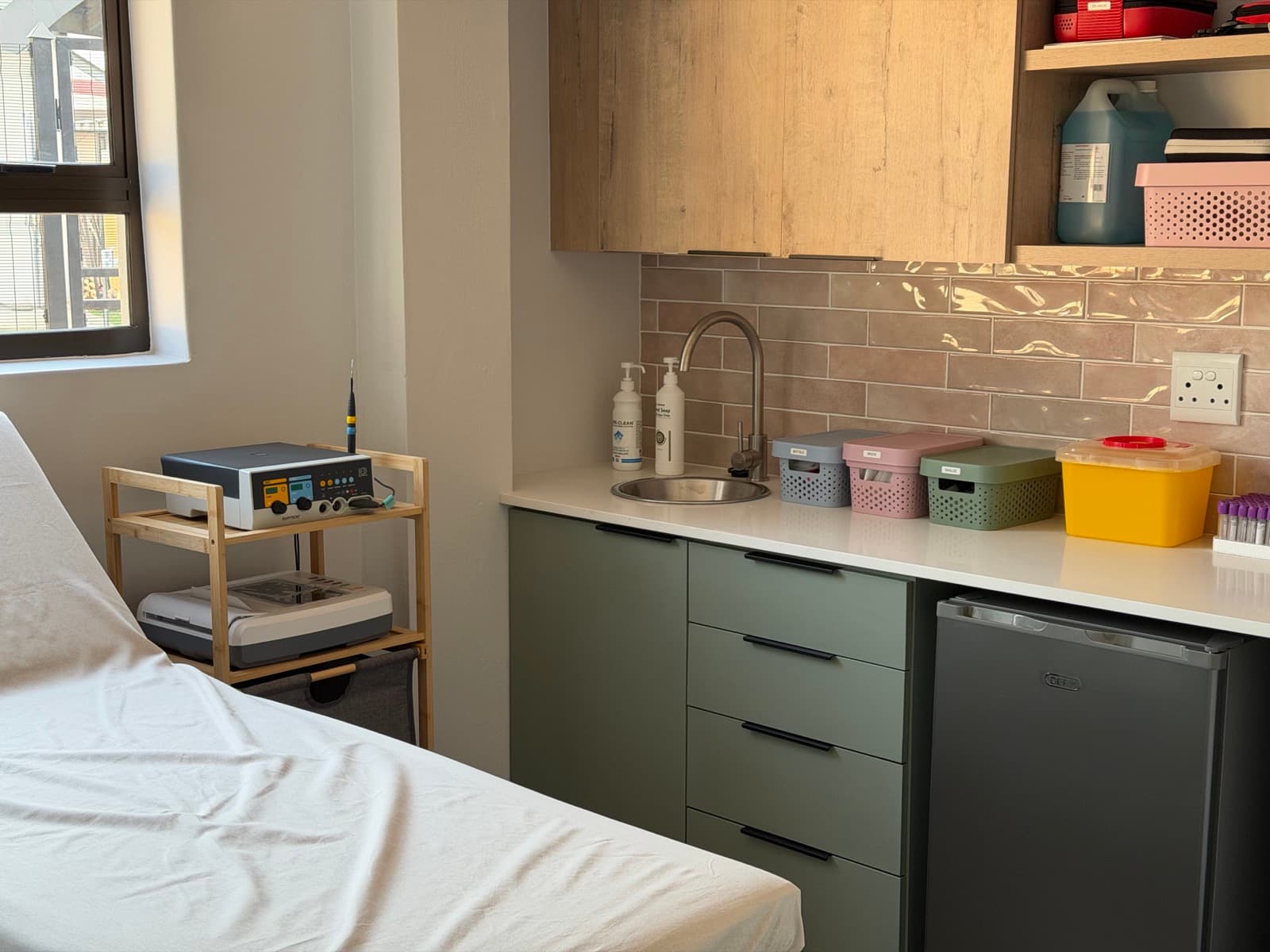
The practice’s private procedure room with an examination bed
Our private procedure room

Feeling at ease, before, during and after.

Most people feel some cramping, like period pain, for a short while. Everyone is different, and these small things can help.

  • Eat beforehand

    Have a light meal so you don’t feel light-headed.

  • Take a painkiller

    A pain reliever such as ibuprofen about an hour before can ease cramping, if it is safe for you. Ask us if you’re unsure.

  • Bring a pad

    Light spotting afterwards is normal, so a pad or panty liner is handy.

  • Bring company

    You’re welcome to bring someone along for support.

  • Breathe slowly

    Slow, deep breaths help your muscles relax during the procedure.

  • Speak up

    Tell Dr. Madri if you feel anxious. You can ask questions or ask to pause at any time.

After your insertion, what’s normal.

  1. Today

    Cramping and light bleeding are common. A hot water bottle and pain relief help, and many people carry on with their day.

  2. The first few days

    Cramps usually ease within a few days. Tampons and your usual activities are fine.

  3. The first 3 to 6 months

    Your periods may change while your body adjusts. Hormonal IUDs often cause spotting at first; copper IUDs can make periods heavier.

When does protection start?

Copper IUD
Straight away.
Hormonal IUD
Straight away if it is placed in the first 7 days of your cycle. Otherwise, use condoms for the first 7 days.

IUDs don’t protect against sexually transmitted infections. Condoms do.

Contact us if you notice

  • Pain in your lower tummy that is severe or getting worse
  • A fever, or feeling unwell and shivery
  • Unusual or smelly vaginal discharge
  • Very heavy bleeding
  • Pain during sex
  • You can feel the IUD itself
  • You think you might be pregnant
WhatsApp 060 012 0681

In an emergency, go to your nearest emergency unit.

Good to know, the honest details.

Complications are uncommon, and Dr. Madri talks them through with you before you decide.

  • 1 in 20

    An IUD can move or come out, most often in the first few months.

  • Up to 2 in 1,000

    Rarely, an IUD can pass through the wall of the uterus during insertion.

  • First 3 weeks

    There is a small risk of infection after insertion. Contact us if you notice any of the signs listed here.

Your questions, answered.

Does it hurt?

Most people feel cramping, like period pain, during the insertion and for a short while afterwards. It is different for everyone, and it is over quickly. Let us know if you’re worried about pain, so we can plan together.

Can I have an IUD if I haven’t had children?

Yes. IUDs are suitable for most people, whether or not they have had children.

Will my partner feel it?

The IUD sits inside the uterus, so it can’t be felt during sex. Occasionally a partner notices the threads; if so, they can be trimmed a little shorter.

Can it get lost in my body?

No. The IUD stays in the uterus. The threads sometimes curl up out of reach, which isn’t necessarily a problem. Ask us if you’re unsure.

When can it be removed?

Whenever you like. Removal is usually quick and simpler than insertion, and your fertility returns soon afterwards.

Can I use tampons?

Yes, tampons are fine with an IUD.

Let’s talk it through, with time for every question.

Book a consultation to find the IUD that suits you. Bring your questions; no question is too small.

This guide offers general information and doesn’t replace a consultation with your doctor.

Book on WhatsApp